// services / local search
Local SEO consultant for the searches that end in a phone call
I'm a remote local SEO consultant for WordPress small business sites. Google says local results are mainly based on relevance, distance and popularity. Only some of that is yours to change, and less of it is mine. I'll fix the part that is, tell you plainly when the real constraint is something neither of us can buy, and measure it where it can actually be seen.
// what it costs
- US$149Deep audit and growth report, one off, on Upwork
- US$999Audit and fixes, one off, on Upwork
- US$299 or US$750month to month, with a report every month
Audits from US$149, audit and fixes from US$999, and month to month plans at US$299 for maintenance or US$750 for growth. Booked and paid on Upwork.
What is local SEO, and how is it different from SEO?
Ordinary SEO asks whether your page deserves to rank. Local SEO asks that too, then adds a question the searcher never types: where are they, and are you near enough to be useful. That second question is why a page can be the strongest answer on the internet and still lose to the business two streets away.
It plays out across two surfaces. The local pack, the map result near the top, leans heavily on your Google Business Profile, the listing most owners still call GMB or Google My Business. The local organic results below it are ordinary web pages. They aren't the same machine, but they aren't sealed off from each other either: the same business facts, the same reviews and the same website can inform both, which is why fixing one and ignoring the other tends to disappoint.
How would I diagnose this on your site?
This is the order I check it in on a WordPress or WooCommerce site, before changing anything. You'll get the findings back in writing, each tied to a number in your own Search Console.
See my full diagnosis process- i.
Your profile and your site, side by side
Whether the business type, categories, services, hours, address and phone agree. When they don't, there are two versions of the business in circulation, and the relationship between the business, its services and its location is harder for anything to read.
- ii.
Search Console filtered to near me and place-name queries
Which local searches you already surface for, and where. A query sitting at 11 with real impressions is usually closer to the money than a new page.
- iii.
Index coverage on every service and location page
Pages in Crawled, currently not indexed can't appear in the local organic results at all, and that's a different fix from anything local.
- iv.
The local queries you're not in at all, and who is
The service and place combinations worth a page, and what the businesses currently taking them have that you don't: categories, location pages, reviews, or links you'd have to earn.
Showing up for the trade but not for the town?
Book a call on UpworkHow does Google decide who ranks in the map pack?
Google Business Profile Help says local results are mainly based on relevance, distance and popularity. Reading your own situation against the three tells you quickly whether hiring anyone will help, and it's worth knowing Google also states plainly that there's no way to request or pay for a better local ranking.
| Factor | What Google says it is | Who can move it |
|---|---|---|
| Relevance | How well a Business Profile matches what someone is searching for | Partly you, partly me. Categories, services, business information and the site behind them can all be made accurate and specific |
| Distance | How far each business is from the customer who's searching | Nobody. It changes with every searcher, and no setting moves your premises |
| Popularity | How well-known a business is, based on info like how many websites link to your business and how many reviews you have. Google's wording is 'info like', so reputation and mentions across the web sit in here too. Google's own heading for this factor is prominence | You, slowly, by earning it. I won't write, buy or solicit reviews or links on your behalf |
What goes wrong with local SEO on a WordPress site?
The faults repeat across trades, and none of them are exotic. They're maintenance nobody did.
Markup that contradicts the profile
Structured data carrying an old address, different hours, or a business type that doesn't match the profile. Conflicting information makes it harder for anything to work out what the business actually is.
Service pages that were never indexed
A page Google hasn't indexed can't appear in the local organic results at all. It's the first thing I check, and it's more common than owners expect.
One page doing every service and every suburb
A single page trying to be the plumbing page, the heating page and the page for four quadrants dilutes its own focus, and serves each specific search less well than a page written for it would.
A name, address and phone that drift
Footer, contact page, markup and profile each carrying a slightly different version, usually after a move or a rebrand.
Local keyword work never done
Nobody checked which service and place combinations people search in your area, so the pages got named after what the business calls things internally. After-hours searches are often their own market: the veterinary SEO page shows 'emergency vet calgary' searched 1,600 times a month, as often as plain 'vet calgary'.
A conversion path that breaks on a phone
The number isn't a tap-to-call link, the form sits below three screens of copy, or the profile points at a page that loads slowly.
How do I optimize my Google Business Profile?
Set up accurately and aligned with the site, yes. Run week to week, no. I'll say that up front instead of billing you for something you'd do better yourself.
What I do
- Categories, services and business information checked against what you actually sell
- Your site's markup, hours, address and phone made to match the profile
- Service area set up accurately when you've no address the public can visit
- The profile's website link pointed at a page that's indexed, relevant and fast
What stays yours
- Asking customers for reviews, and replying in your own voice
- Posts, offers and photos
- Answering questions on the profile
Does this work without a storefront, or with several locations?
Three shapes of business, three different setups. Getting this one wrong is the expensive mistake in local search, because it's the one that can put a profile at risk. The industry pages work each shape through by trade, from SEO for dentists, whose patients come to the chair, to trades whose vans go to the customer.
A place customers visit
The address is real and public, and distance is measured from it. The website should make the same facts as easy to find as the profile does.
A service area business
You serve customers at their address and yours stays hidden. You declare the areas you actually cover. Listing an area doesn't make you rank across it, because distance still applies from where Google understands you to be, and a rented mailbox used to fake proximity is the kind of thing that gets profiles suspended.
Several real locations
Each genuine, staffed location can have its own profile, and the site may deserve a page per location carrying that branch's own details. Duplication is the risk: near identical branch pages compete with each other and help nobody.
Should you build a page for every area you cover?
This is where local SEO turns into doorway pages, so the test is the one I used building the 31 Alberta town pages on this site: cut the shared blocks until each page reads as its own, and if it can't, it doesn't get published.
Deserves its own page
- You'd take the job there tomorrow
- There's something true and specific to say: response times, housing stock, permits, a job you've done
- People search for that service with that place attached
- It stands up without the place name doing all the work
Belongs in a section, not a URL
- The same page with the suburb swapped, twenty times over
- Areas you'd quietly decline if the phone rang
- Towns listed for coverage, with nothing behind them
- A variation that answers the same question as a page you already have
Do citations, reviews and local links still matter?
Google names links and reviews directly when it explains popularity, so yes, though not the way the directory-blast industry sells it. Accurate, consistent business information on the platforms that matter for your trade supports the same picture your site and profile are building. Hundreds of thin listings bought in a bundle mostly support the seller. If your details are inconsistent across the places customers and search engines already look, that's worth correcting once, properly.
Reviews are the same story. How many you have, how good they are and how recent they are all feed how a business looks to a person deciding, and Google counts them in popularity. Owner replies read strongest in the owner's voice. What I won't do is generate, incentivise or filter them, and I'll turn the work down before I set up something that risks your profile.
Local links and mentions are the part technical work can't manufacture. Sponsorships, suppliers, trade bodies, genuine local press. If your bottleneck is that nobody links to you or talks about you, no amount of markup fixes it, and I'll tell you that's where the money should go instead.
What do you check that you don't actually manage?
Half of local search sits outside what I sell. I still read it, because telling you the website isn't your problem is worth more than selling you website work that won't move anything.
Your review profile
How many, how recent, how you reply. If you're three reviews deep against competitors on two hundred, that's the bottleneck and no markup fixes it.
Listing consistency
Whether your name, address and phone say the same thing on the platforms that matter for your trade. Wrong ones are worth correcting once, properly.
Local links and mentions
Who links to you or talks about you, and who links to the businesses above you. Often the whole gap.
Competitor prominence
What the businesses currently taking your searches have: categories, location pages, reviews, links. It tells you what you're actually up against.
How do you measure local SEO results?
Search Console can't see the map pack, so anyone showing you only Search Console is showing you half the job. Three layers, three sources, agreed before the work starts.
The website layer
Search Console: impressions, clicks, click rate, the queries you surfaced for and the landing pages that earned them. Position there is an average across every search it saw, which makes it a diagnostic, not your rank.
The profile layer
Business Profile performance: views, the searches people used to find you, calls, website clicks, direction requests, messages and bookings. This is the only place the map side of the work shows up.
The money layer
GA4 and whatever you count enquiries in: organic sessions, the pages they land on, forms, bookings and calls where tracking exists. This layer decides whether the work was worth buying.
Position, plainly
Local pack results change with where the searcher is standing, so one number can't describe a city. Where it matters, position gets checked across a grid of points around your service area, not reported as one rank.
What does local work look like when it lands?
Three projects with local evidence in their own case studies. Each figure is from that client's Search Console over the period the case study states, and none of them is in Calgary. For Calgary itself, local SEO in Calgary has the pack data by trade. These cards show what changed alongside the work, which isn't the same as proof the work alone caused it.
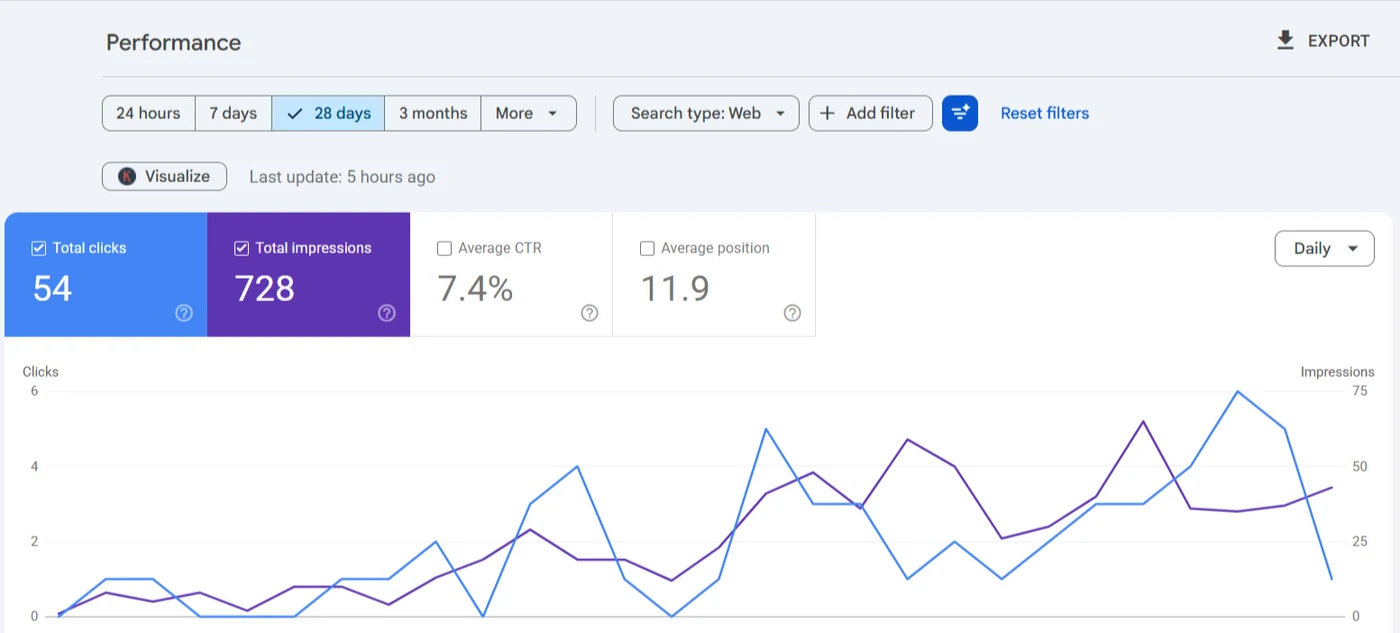
A new site in Arlington, Washington. 'Gas fireplace service near me' sits at 3.0, 2 clicks from 10 impressions in that window. The schema, headings and Jobber booking went in before launch, not after it.
Read the case study →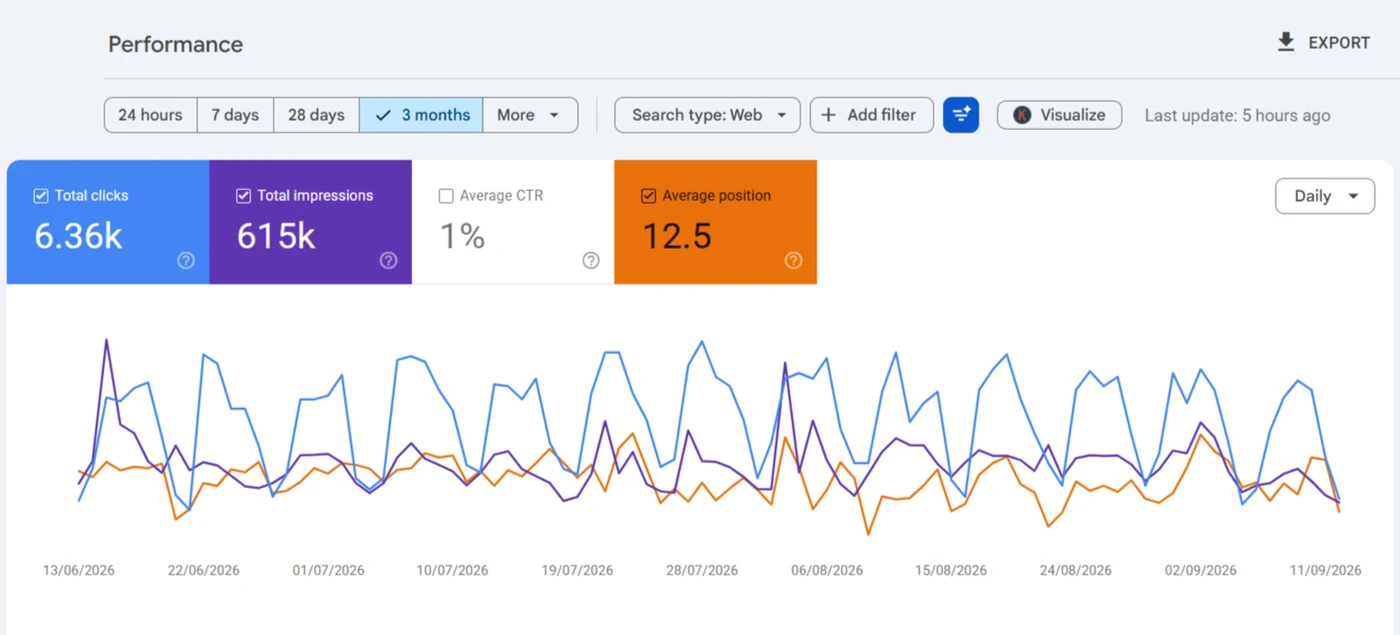
Against a 1.04% site average. Location pages written for what parents actually type outperform the rest of the site, and 'aba therapy near me' holds 11.5 on 1,895 impressions.
Read the case study →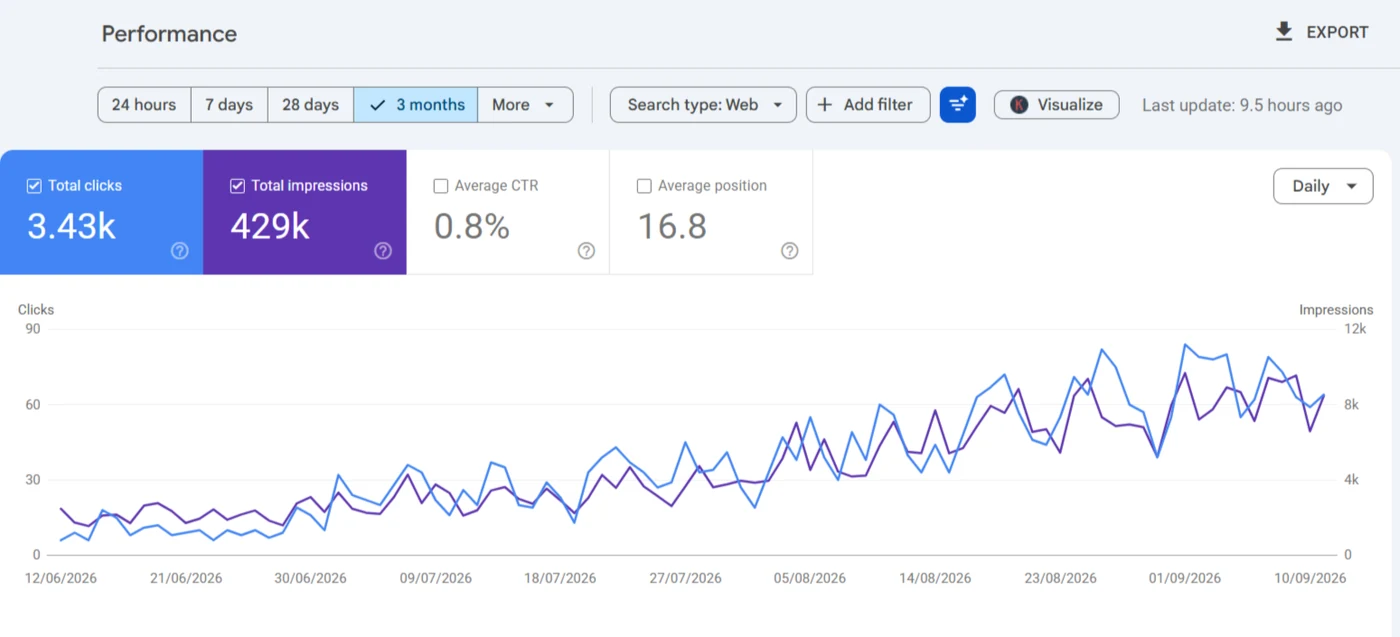
The long, specific near me query ranks where the broad one doesn't: 'scrap my car near me' sits at 13.2 on 1,222 impressions. On this project the specific variant clearly outperformed the broad one.
Read the case study →Should you hire a local SEO consultant or an agency?
Most people searching for a local SEO specialist or a local SEO consultant want the same thing: somebody competent to take this off them. Here's the honest trade, because an agency is the right answer for some of it.
An agency suits you when
- You want local digital marketing run as a whole: ads, social, email and search together
- You need reviews chased, citations built and profile posts written every week
- You want account managers, monthly reporting and cover when someone's away
- Your budget is a standing monthly retainer, not a piece of work
One consultant suits you when
- The problem is technical and you want the person who does the work doing it, not briefing a junior
- You'd prefer a scoped package to a retainer that keeps running
- You want to message the person who found the problem and get an answer within one business day
- You want the consulting and the fixing from one person, and to be told when the answer is reviews and nothing billable
Who books a local SEO consultant like this, and from where?
Everything runs remotely, so where you are decides your map pack, not whether I can do the work. Most of it is Alberta and the rest of Canada, on Mountain Time, with UK and US clients on their own hours.
Owners, direct
- One business, one profile, and the site that profile points at
- You want more calls and suspect the website is what's in the way
- You want local SEO services for a small business as a fixed scope, not a retainer
Agencies and studios, white label
- Local work under your brand, and your client never hears my name
- A written report you hand over as your own
- Fixed scope per project, no commission and no approaching your client
What schema does a local business website need?
The closest accurate type for the business, not the longest one. A fireplace business marked up as the business it is says more than a generic organisation, and the name, address, phone and hours should match what the profile carries. A service area business can declare the areas it serves instead of an address a customer would turn up to.
Two things worth being clear about. Markup helps machines read a page correctly, and it's how an answer engine gets your business facts without inferring them from prose. It isn't a ranking switch, and adding more types doesn't add more ranking. Markup that disagrees with your profile is worse than none, because now there are two versions of you. The mechanics live on the schema markup page; the local judgement is here.
What's in local SEO work, and what isn't?
Pages Google hasn't indexed at all are crawlability and indexing first, because no local work reaches a page Google can't see. Prices for the packages this sits inside are published on the homepage and repeated in the terms.
In this service
- Local keyword and competitor research: which service and place combinations are worth a page
- Markup and business information made consistent across site and profile
- Profile categories, services and service area set up against the site
- Service and location pages planned, with the deserves-a-page test applied
- The three measurement layers set up, and a before and after read on each
Not in it
- Review generation, review replies or reputation management
- Profile posts and photo uploads
- Local citations, directory blasts or link building
- PPC, Google Ads or any paid local advertising
- Any promise about a map pack position, which Google decides and nobody can buy
What happens after you book a local SEO consultant?
- i.
The two sides read separately
Your profile and your website, checked against each other, so you'll know which of the two is actually costing you calls.
- ii.
Indexing before anything else
Which of your service and location pages Google has indexed, because the rest of the work is wasted on the ones it hasn't.
- iii.
A quote per group of pages on Upwork
What's worth fixing, what's worth building, and what you should leave alone, agreed before any editing starts.
- iv.
One group at a time
Changes land in batches so each group's movement can be read on its own, four to eight weeks apart.
What else do people ask about local SEO?
How much should I pay for local SEO?
The packages this sits inside are priced on the homepage and in the terms, from the one-off audit through to the month to month plans. What your project costs depends on how many service and location pages need work and whether the profile is set up at all, so you'll get a scoped quote on Upwork once I've read both sides.
What makes affordable local SEO actually affordable?
Not a cheaper hourly rate. It's buying a fixed scope instead of a monthly retainer that bills whether anything needed doing or not. Local SEO packages here get scoped after the call, not picked off a list, so you don't buy work you don't need, and you find out on the call if your problem is reviews and not the website.
Is local SEO worth it for a small business?
It's worth it when relevance is what's holding you back: pages Google hasn't indexed, a profile and site that disagree, or services nobody wrote a page for. When the gap is distance or two hundred reviews against your ten, website work won't close it, and I'll say that on the call before you spend anything.
Can I do local SEO myself?
Parts of it, yes. Reviews, profile posts and answering questions are better in your voice than mine, and I'll tell you how to run them. The site side, markup, indexing and page structure, is where the technical work earns its money.
What's the difference between local SEO and SEO?
Local SEO adds distance to the question, and it plays out on two surfaces: the map pack, which leans on your Business Profile, and the local organic results, which are ordinary web pages. They overlap more than most articles admit.
Will you get me into the top three of the map pack?
No, and nobody truthfully can. Google says there's no way to request or pay for a better local ranking. Distance is fixed, popularity is earned over time, and relevance is the part that's largely buildable. I'll tell you before you pay whether relevance is what's holding you back, and if it isn't I'll say so.
Do service area businesses rank everywhere they list?
No. Declaring a service area tells Google where you'll travel, not where you should appear. Distance still applies, so a business in the north west of a city rarely shows for searches in the deep south east, and faking an address to get around that risks the profile.
Do I need backlinks and citations for local SEO?
Google names links and reviews when it explains popularity, so they matter. Neither is part of this service. What I will do is tell you plainly when links or reviews, not anything on your website, are the actual constraint.
How long before local changes show?
Google has to recrawl the site and re-read the profile, so four to eight weeks before either of us judges it. Indexing fixes can show faster, because a page that was invisible becomes visible the moment it's indexed.
What access do you need to start?
Your URL and read-only Search Console access, which takes two minutes to grant. Business Profile manager access and WordPress admin come later, only when you've approved a scope.
The method's written up in four posts: getting a business ready for Business Profile verification, what moves a listing up in Google Maps, the local SEO checklist I run on a site and testing location pages for doorway risk, all four in the local SEO posts.
For your own trade, the WordPress SEO pages by industry start from that vertical's Alberta map pack, town by town. Plumbers, electricians, glass and window companies, accountants and bookkeepers, med spas and real estate agents each have one, and so do ten more.

Ranking for the trade, but not for the town?
Send me the URL and read-only Search Console access. I'll read your profile against your site, tell you which of the two is costing you the calls, and say plainly if the answer is reviews rather than anything I can sell you.
Book a call on Upwork