// services / stores, moves and recovery
Google penalty recovery services that find the cause first
Most sites that come to me with a 'penalty' don't have one. They've got a noindex tag, a broken redirect map, a hacked plugin or a core update. Book a call and I'll tell you which it is before anyone touches the site.

// what it costs
- US$149Deep audit and growth report, one off, on Upwork
- US$999Audit and fixes, one off, on Upwork
- US$299 or US$750month to month, with a report every month
Audits from US$149, audit and fixes from US$999, and month to month plans at US$299 for maintenance or US$750 for growth. Booked and paid on Upwork.
What do my Google penalty recovery services actually do?
My Google penalty recovery services, from one Google penalty removal consultant, do two jobs in order: prove whether there's a penalty at all, then fix whatever's actually costing you traffic. Most providers skip the first, because Google penalty removal sells better than 'your staging noindex went live'.
Google's documentation doesn't use the word penalty. The nearest thing it names is a manual action, issued when a human reviewer finds pages breaking its spam policies, and listed in Google Search Console. Everything else people call a penalty is an algorithmic reassessment, a technical fault or a hacked site.
How would I diagnose this on your site?
This is the order I check it in on a WordPress or WooCommerce site, before changing anything. You'll get the findings back in writing, each tied to a number in your own Search Console.
See my full diagnosis process- i.
Manual actions and Security issues
Two reports, two minutes. If both say no issues detected, there's no penalty to remove.
- ii.
The drop dated to the day
Daily clicks matched against the Google Search Status Dashboard and the site's own deploys, plugin updates and redesigns.
- iii.
Which pages and queries lost
A sitewide fall points to a sitewide cause; one template falling points to that template.
Traffic fell off a cliff and nobody can tell you why?
Book a call on UpworkIs it a manual action, an algorithmic drop or a hacked site?
The last column matters most, because people spend weeks writing requests Google can't act on. When the Pages report shows URLs sliding into discovered or crawled but not indexed instead, that's a technical fault, and the guide on why Google leaves pages discovered but not indexed explains what each status means.
| Cause | Where it shows | Review request? |
|---|---|---|
| Manual action | Search Console's Manual actions report | Yes, after every affected page is fixed |
| Security issue | The Security issues report, often with a browser warning | Yes, after the cleanup |
| Core or spam update | Nowhere, only a date matching Google's status dashboard | No, there's nothing to reconsider |
| Technical fault | The Pages report and the live HTML | No, recovery starts once Google recrawls |
Which types of Google penalties does Search Console list?
These are the manual actions on Google's own list that a business site is most likely to meet, each with the fix path Google's help page sets out. Google also lists News and Discover policy actions, cloaked images, AMP mismatches and spammy free hosts, which rarely touch a WordPress business site. A hacked site isn't on the list at all: that's the Security issues report. A thin content action is content audit work before it's a request.
| Manual action | What Google found | The fix path |
|---|---|---|
| Unnatural links to your site | A pattern of artificial or manipulative links pointing at you | Export your links from Search Console, get the paid or scheme links removed, disavow the rest, then request a review |
| Unnatural links from your site | Paid or manipulative outbound links on your pages | Remove them, or mark them nofollow or sponsored, then request a review |
| Thin content with little or no added value | Thin affiliate pages, scraped content or doorways | Improve, merge or remove those pages, then request a review |
| Cloaking and/or sneaky redirects | Different pages shown to Google and to visitors, or visitors sent somewhere Google didn't see | Find the code or plugin doing it with URL Inspection, remove it, then request a review |
| User-generated spam | Spam posted by visitors in comments, forums or profiles | Delete it, then add spam controls to the forms and profiles it came through |
| Structured data issue | Markup for content that's invisible, irrelevant or misleading | Correct or remove the markup so it matches the visible page |
| Hidden text and/or keyword stuffing | Text visible to the crawler but not to a person | Remove the hidden text and repeated keywords, then request a review |
| Major spam problems | Aggressive techniques such as scaled content abuse or cloaking | Remove the spam and document what replaced it; the request should show examples of both |
| Site reputation policy | Third-party content that breaks Google's site reputation policy | Find the third-party sections affected and bring them in line with the policy |
| Back button hijacking | Code that stops visitors getting back to the page they came from | Remove the script or import responsible, then request a review |
How do you write a reconsideration request?
Fix every affected page first, then select Request Review in the Manual actions report. Google's help page says a good request does three things: 'Explains the exact quality issue on your site. Describes the steps you've taken to fix the issue. Documents the outcome of your efforts.' Mine are written in that order, with URLs and dates.
The evidence carries the request, not the apology. For a links action that means the spreadsheet of links, who was asked to remove each one and what happened, plus the disavow file. For thin content it's the list of pages improved, merged or removed. Google says most reviews take several days or weeks, link-related ones can take longer, and you shouldn't resubmit before you get a decision on the one that's outstanding.
What does a drop that only looks like a penalty cost?
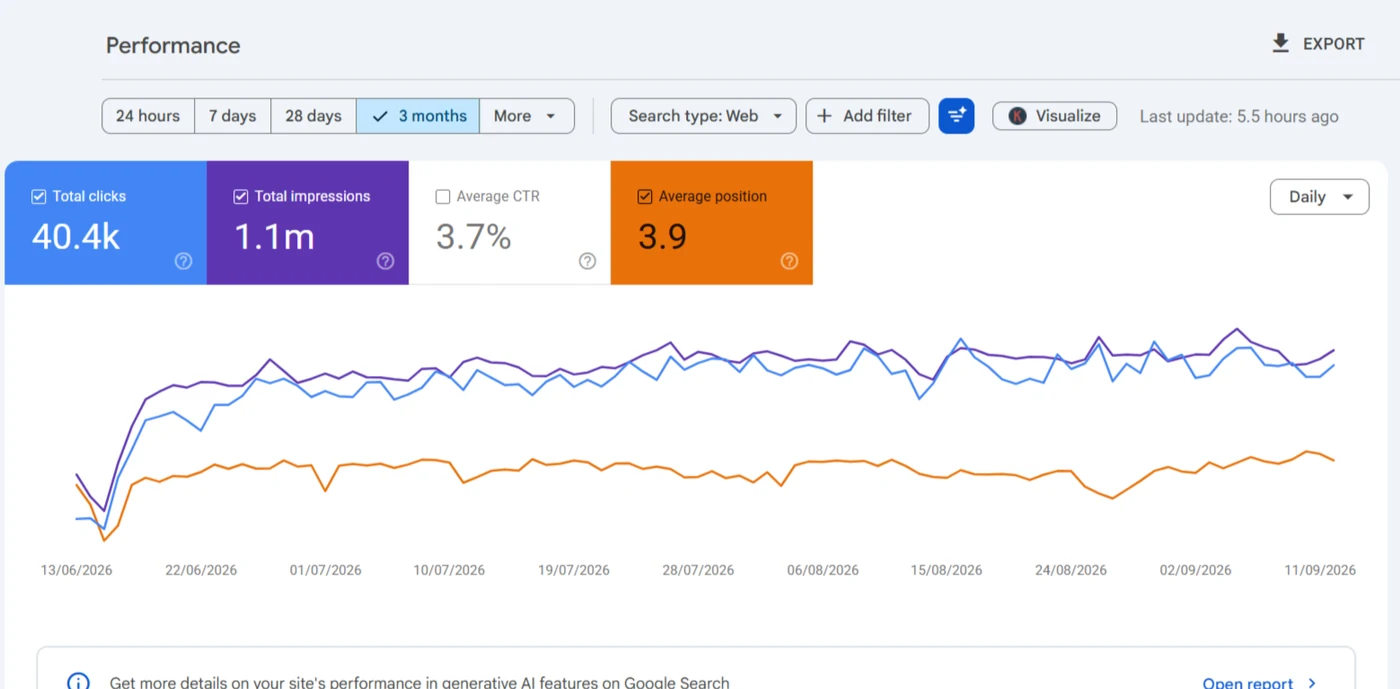
The GK Jewelers case study is the clearest example I've got. It isn't a manual action case, and I don't have a published one to show you; it's the more common story, a drop that looked like a penalty and wasn't.
What shouldn't you do in the first week after a traffic drop?
Each of these tangles a second change into the diagnosis.
Rewrite the site
New copy, templates and URLs make it impossible to tell what caused the drop and what caused the recovery.
Disavow everything a tool flags
Without an unnatural links action, a mass disavow can throw away links that were helping you.
Send a review request with no action to review
If the Manual actions report says no issues detected, there's nothing for a request to lift, and the time's better spent on the real cause.
What's the recovery timeline for each kind of drop?
Technical faults reverse within days of the fix, and manual actions add Google's review, which Google puts at several days or weeks. Algorithmic drops are slow, and anyone quoting fixed days for those is guessing.
What's covered in penalty and drop recovery, and what isn't?
Where the pages that lost are thin or duplicated, the work carries on under thin content and pruning.
In this service
- The drop diagnosed in a fixed order, with dates and evidence
- Manual action cleanup and the reconsideration request
- Link audits and disavow files when an unnatural links action exists
- SEO cleanup after a hack
Not in it
- Malware removal and server hardening
- Promised recovery dates
- Drops caused by a move, handled as a site migration
What happens after you book Google penalty recovery services?
- i.
Two reports before the call
I'll check Manual actions and Security issues with read-only access first. If both are clear, you'll hear that on the call.
- ii.
The drop, dated to the day
Daily clicks lined up against Google's update dates and every change your site had that month.
- iii.
A written diagnosis and scope
What caused it and what fixes it, quoted on Upwork before any work starts.
- iv.
Fixes, then honest numbers
A revoked action and recovered traffic get reported separately, because they aren't the same thing.
What else do people ask about penalty and drop recovery?
How much do Google penalty recovery services cost?
A Google penalty removal service is priced by the cause, and nobody knows the cause until the diagnosis, so there's no price here. The diagnosis is scoped first, then the fix gets its own quote on Upwork.
How do I know if my site has a Google penalty?
Open Search Console, then Security and Manual Actions. If Manual actions says no issues detected, there's no manual penalty, and the drop is algorithmic, technical or a change in the results page.
How do you recover from a Google penalty?
Match the fix to the cause. A manual action needs every affected page fixed and a reconsideration request. A security issue needs the cleanup and a review from the Security issues report. A core update needs better pages and time, with no request to send.
Should I disavow backlinks after a traffic drop?
Only if there's an unnatural links manual action, or you know links were bought at scale. Google mostly ignores spammy links on its own.
Can a hacked WordPress site lose its rankings?
Yes. Injected spam pages and malware warnings both cut traffic. After the cleanup, a review is requested from the Security issues report, and if Google's stopped indexing pages that's crawlability and indexing.
If the drop followed a hack, this is how I check what a Japanese keyword hack did to a site's rankings before any clean-up starts. If it lines up with a relaunch instead, protecting rankings during a redesign covers the search side of that.

Traffic dropped and you don't know why?
Send me the URL and read-only Search Console access. I'll date the drop to the day, check manual actions and security issues first, and tell you plainly whether it's a penalty or something else.
Book a call on Upwork